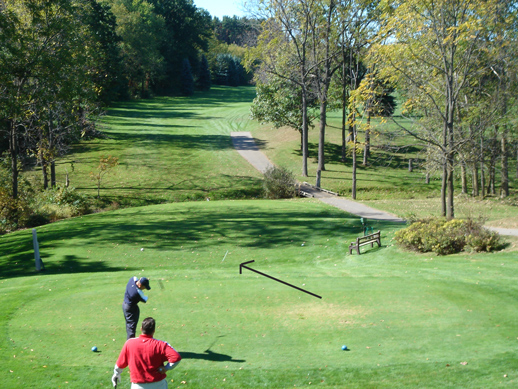
The most difficult hole on the course challenges the
right-to-left player most. The tee-shot is blocked on the right by tall trees, almost
forcing a fade into the narrow fairway. But heavy woods line the left and trouble the
pulled shot.
The most effective bail-out strategy is to hit the ball high
over the trees on the right into the open area. But a ball that hits these trees risks
falling into the creek that is 50 yards off the tee.
 |
|
Charlie Shoop's third shot to the 18th green in the 2000
event. He would eventually sink a six-footer for a five to tie the
points and retain the cup for Blue.
|
This hole is made tougher for those giving strokes, and has
often been the number one handicap hole. The pressure is on the lower handicap player to
close a match before it gets here. In 1996, the Concord Cup committee changed the course
handicap rankings so that players would not be forced to give strokes on the hole. Due to
pressure from the players, the committee reversed the decision the following year. Again
in 1999, the committee changed the handicap of the hole to number seven.
In 1996, Dennis
Hackett sunk a 12-foot par putt here to halve a match with Charlie Shoop and clinch
victory for the Red.
 |
|
The required left-to-right drive causes some players to bail
well right. Here in their key 2005 match, Jeff Hackett tees his ball well right
(see the arrow) and Vince Olenik played in that direction as
well.
|